DLWS Michigan. It was raining. Hard. So we didn’t get to go to a lighthouse, one of my favorite things. Stayed indoors, and pooled our flashes. Group A, B, and C. Total, 25. I personally think it had nothing to do with technology, it had to do with this charismatic group of photo folks levitating the light out of their SB units.
Great DLWS, even though it was held in the middle of nowhere. Though someone corrected me today, quite defintively, telling me that it was not the middle of nowhere, but that Traverse City was the biggest city in the lower portion of the Upper Peninsula of Michigan. Or is it the upper part of the lower peninsula? That’s where I was? How does Moose Peterson get me to go to places like this where there’s a whole lot of wet leaves on the ground?
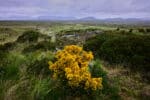
But I am trying, lest Moose loose patience with my meager landscape efforts. I did shoot a tree. And I enjoyed my walk in the forest.

But I have to admit, being a people shooter, I was far more interested in doing a portrait of one our participants, Kim. (Also shot at f2, like the tree above.)

Shot with an Ezybox Hot Shoe Softbox, toted by Drew, who was using a Sylinator paint pole light lifter. Had a good time just working down the light to accomodate f2. Been experimenting a bit lately with real minimum DOF portraits. Dicey with the sharpness thing, but fun to do.
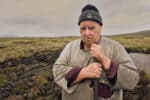
Then, the best thing of the trip happened. We went to a deserted beach. It was deserted for very good reasons, in that it was freezing and raining. But a couple of terrific free spirits had slept out on the beach for the whole night, hoping for some wave and wind action in the morning, and instead found their isolated stretch of sand invaded by about 40 folks with cameras. I approached one of them, JonTan, and simply asked, you know, how about making a few pictures?

It was the picture of the trip. Shot again with the Ezybox on the end of the Sylinator. My thanks go out to Vlad and JonTan, who were very patient with our us and all of our pixels.
THIS JUST IN…..
In DC today, doing a stop for Kelby Tours. Doing live lighting for 5 hours in front of over 800 people. What could go wrong? Shot below is from the first one I did, in San Fran. (Pano stitch by Drew Gurian.)

Like before, I’m sure I’ll be so damn nervous I’ll be in the hallways out back of the place, looking for a place to yak…and then I’ll get a camera in my hands and it’ll be okay.
STUDIO SHENANIGANS…..
Will Foster, a great guy who freelances with us, was so impressed by Drew’s workflow blog he went ahead and re-christened him……DREWBO!

I can just see Drew now, standing in front of the computers in the office going, “Okay pixels, I’m comin’ for ya. This time it’s personal……”
More tk…..
So this is one of those topics Joe and I are asked about on a very regular basis. We usually just answer these questions one-by-one, but got an interesting email from one of our readers, Jose Fernandez, a little while back, and figured I might as well just lay it all out.
Here’s why I do the post-processing, not Joe:
As a disclaimer, and to cover my ass, I’ll be the first to admit that we as a studio don’t necessarily do things the “right” way. Are we entirely satisfied with our post-production/archiving process? Not exactly. The thing is, any busy photo studio is constantly producing massive amounts of imagery, and keeping up with it all isn’t always a walk in the park. On top of that, technology is one of those amazing things that we all are challenged to stay on the cutting edge of. Computer software, hardware, camera gear- it’s all evolving so quickly, that even if you know your best option today, in another week there’s something else out there that’s potentially better.
Speaking of which, we’re happy to say that our entire studio is now archived on Drobos. We’ve had three 4TB Drobos, along with an old Apple X-Serve RAID (8TB) for some time now. Just made the move to off the old X-Serve RAID and replace it with a 16TB Drobo Pro, which is much quieter, more energy efficient, and the user interface is much more intuitive. Funny (well, not really) how five or six years ago, that old X-Serve was top-of-the-line, cost well over 10K for 6TB of storage, and we’ll be lucky to sell if for a grand now…oh technology.
As for the hardware basics, we have four workstations in our studio, which is entirely Mac-based. Each station is equipped with an Apple 30″ Cinema Display, and mine is also graced with a Wacom 21″ Cintiq. Sounds like a lot of screen space, and it is- but having all this speeds up the post-process tremendously. The Cintiq brings a lot of fun back into editing, that you never knew was there with a mouse. Once you build one into your workflow, you’d have to be dragged kicking and screaming to go back to a mouse.
I’m not gonna get into PS tutorials, color calibration, etc., as not to bore you to death, but I do hope to just lay out the BASICS of our workflow, and hopefully start a discussion with all of you- so here goes.
The Software: Aperture is the heart of our system. We organize our files on it, and shoot tethered with it in the field. Joe also does his slide shows out of Aperture. It’s a really varied program with lots of processing and organizing power.
-Whenever we can on location, we shoot tethered into Aperture or Nikon’s Camera Control Pro 2. Both are great programs in their own right, but there are certain strengths of each which dictate which one will be used in specific situations. The loupe tool in Aperture is a great quick way to double check sharpness while on the fly, and we can easily compare recent shots side-by-side (which CCP doesn’t do). Aperture also allows the camera to write to the card as well as the computer, which the current version of CCP does not. (Which can be dicey.) With that said, for demo purposes at workshops and such, Aperture’s a no-brainer, since we’ll typically shoot jpeg’s at these types of events. When it comes to RAW files, they both have issues, so take your pick.
Another occasional tool we use for quickly browsing files in the field is Photo Mechanic. It’s a really fast, down and dirty way to view thumbnails and make selects.
-We import our cards using Aperture’s Card Importer, a plugin for the program that let’s us import up to eight card simultaneously, while adding metadata.
-From there, the photos go either through Nikon’s Capture NX2, then to Photoshop, or sometimes directly into PS. Really all depends on what I’m trying to do with the photos. Each program does certain things better than another, and it’s all obviously preferential. One very cool feature in NX2 is the Color Control Point tool, and I’d suggest downloading a free trial and giving it a go- If you shoot Nikon. (Joe loves this program. He refers to it as PhotoShop for dummies. One click saves lots of potential layers in PS.)
Not to go too deep into this, but in PS, there’s a million things you can do, and even more ways of getting there. ”Typically”, I start with a layer to remove any dust, minor blemishes, etc. From there, it’s on to curves, etc., etc.. We also have really grown to love the PS plug-ins made by Nik Software. Used in moderation, they help us make certain effects take minutes which would typically take much longer to do…definitely one of the most useful additions to our post prod. process as of late. For a small operation like ours’, with limited staff, time is a huge factor, and the Nik options really can cut hours out of the post process.
One important point to make is that there generally isn’t a huge amount of post done in our studio. Joe comes from the Kodachrome generation of sorts, and I’m very lucky to do his post, as he’s one of the few people I’ve ever known who consistently produces near perfect files right out of the camera, and I truly don’t mean that to kiss his ass. If there’s one lesson to learn from all this, it’s that last sentence. After all, if your photos aren’t so hot when you shoot them, they’ll probably still suck after post-processing, right? Strive to make that great frame while shooting, not in post. That’s a whole different discussion though..
-The last step in our process really comes down to organization. There’s many ways to go about this, but our weapon of choice for the past few years has been Aperture. We do all of our key wording and folder organization here, and it’s really a lifesaver. After all, part of my job is to keep track of almost 30TB of digital files. I can easily search for any file we need and output a “version” of that file, while never moving the original. There’s a handful of other programs like this, but Aperture just seems to make the most sense to us.
All of our slide presentations are also done through Aperture, and it’s great to be able to use the bluetooth Apple remote to go through it all.
Like I mentioned in the disclaimer at the start, this isn’t necessarily the “right” way do do things, and nobody can tell you the right way (sorry). As a photographer, part of your job is to find out how several people you admire work, and take what you wish from it, and I guarantee that if you walked into a room of 10 top shooters, all would have different advice.
Hope this covers most of the basics, and feel free to comment back with any other questions..
-Drew
Last day of this October’s version of Jay’s workshop, or, more descriptively, the class the sun forgot. We’ve had about two hours of decent sunshine this week, and tried to make something out of it. It’s been a good week. Jay tore a hole right through the picture I posted yesterday when I showed it. He pointed out the lettering, “PAR,” “Zurich,” and “Yahoo,” hijacked any discussion the photo might have started with a prospective viewer. I was not wild about the pic, but liked some of the color and mood, which enabled me to not really consider my choice in an complete way. (This is why we need editors of our work.)
Thing is, he’s right. Ever been to a meeting where somebody who hasn’t done their homework, or feels compelled to assert some sort of superiority, or whose therapist is on vacation, goes off on an irrelevant tangent for several minutes while the rest of the folks present engage in eye rolling exercises? I think that’s what Jay was saying. Those elements he brought to my attention are like that guy at the meeting, squashing meaningful discourse by clamoring for attention and distracting everybody. He also pointed out the bus on the right was not really a New York City bus.
I will try this again.
So I went out and photographed a man with sad eyes….

Classic Jay: A guy comes to him with a whole tray of slot canyon pictures. First one comes up, and Jay says, “This is nice. But, you know, I don’t think you’re challenging yourself shooting all this stuff, cause I’ve never really seen a bad picture of a slot canyon.” Second one comes up. Jay turns and says, “On second thought…..”
It’s interesting now, shooting on the street. The two pictures I feel strongest about I am reluctant to throw up on the blog. One had really nice gesture. A couple in a bar. They knew I was shooting them, and were okay about it. Their body language was great. Lots of questions as I look at the pics. Beginning of the relationship? End? Chance meeting? Pretty wonderful, the imaginings one could have.
The other was of a mentor relationship between a young boy and a 30 something guy. On the subway, the guy was showing the youngster how to warm his hands by rubbing them together. Nice moment. But, it’s a kid and I just dunno. Also, I shot it on the subway, and the pixel police might get me. The way we live now reminds me of a cartoon I saw years ago where this doofy guy comes out of his house in a bathrobe to confront soldiers, tanks, helicopters and a couple of trench coated G-men on his doorstep. They look at him and say, “We understand you tore the little tag off your mattress.”
More tk…..
Classic Jay: “Carry a camera. It’s tough to take pictures without one.”

He ain’t talking about an Iphone either. Jay is one of the few shooters who walks it and talks it. He has his camera with him. All the time.
A frame on the screen during today’s critique. Jay turns…..”I am not amused.”
What am I getting here? A great message, apropos of the pic above. “Leave the city of your comfort and visit the wilderness of your intuition.” And, presumably, survive out there. My out there, you might imagine, is kinda, you know, out there.
Duane Michaels lectured yesterday. Funny, brilliant man. “Find your bliss,” was the message. Walter Iooss is here today, who I described in Moment It Clicks as the coolest guy on the planet with a camera. Forget about all those guys with helmets and pads. Hope he shows supermodels:-)
More tk….
So I’ve got some stuff teed up on Aperture, and Jay walks by. There’s a series of frames I shot from the same vantage point visible. He looks. “Way to go, McNally. Great variation. We’re your fucking feet nailed to the floor?”
No. Maybe just my brain. Had a tough day yesterday. Photographers. Sometimes, we are just so grandly, naively stupid. We hit the streets, our freshly scrubbed faces brimming with the enthusiasm and certainty that our next great frame is just around the corner, basking in newly minted sunlight. Given our general level of brio, it is sometimes confounding and disappointing to realize that not everyone in the world has signed on to this particular march of the pixels with equal vigor, or even reluctant compliance. That a lot of folks, for instance, in NY’s Chinatown, don’t give a rat’s ass you are trying to make art out of the dead fish they are busy making a living selling. There is nothing quite as shrill at 7am as the irate voice of a 75 year old female fishmonger telling you (presumably) to get our of her damn way and that she is convinced you are a mangy, homeless son of a dog and back in the ancestral village of her youth, she would find an entirely different, more practical use for you.
Shooting on the street. It’s sometimes like telling a joke that no one gets. Awkward, in a word. Why isn’t anyone laughing? Con Ed workers dress in orange safety jackets and blue helmets that look great in early light just for photographic purposes, don’t they? So why did they eye me suspiciously and send over the supervisor to question me?
Sigh. The brisk pace of our discovery process becomes a trudge, and the brioche french toast in that hip eatery on the corner of Prince and Lafayette is sounding mighty good. Shelter from the storm. Coffee.
But then you step back out into sunlight, and the camera comes up to your eye automatically. Like breathing, it is something you must do.

More tk….