It’s actually real. Just got sent a copy, and physically held it in my hands. It’s hefty, at 420 pages. I was feeling good for about thirty seconds, but I am cut no slack in my studio. Drew came up to me and nodded approvingly. “It’ll make a good doorstop,” he said.
So it goes. I do have apologies to offer, because this book was supposed to have been done long ago, and there are some folks (bless them) I’ve heard from who have left their pre-orders ride for over a year. Really, truly, apologize. The last couple years have been assignment work run amok, and I’ve had to improvise and re-invent our studio schedule constantly to just keep going out on location. (Which is where I am today, in an open field with a bunch of folks looking at me and expecting that I should know what to do next. Heh, heh–are they in for a surprise!) The delays weren’t entirely self-inflicted–I did wait to experiment with some light shapers, radio TTL and the like as they came on board. And, thankfully, we have been very assignment driven for the last year and a half. Lots of shooting. No down time.
This book was a long and winding road indeed. I looked at tried and true methods, new technology, big flash, and small flash. I experimented with lots of light shapers, both store bought and found, in the studio and on location. I pushed light through umbrellas and windows, off walls and cardboard, and into soft boxes and panels. I disclosed everything I did, via text, sketch and/or production photos. As I mentioned in the intro sections: “There’s a ton of basic information in this book. there are pictures, sketches, production photos, notes, and metadata. In most instances, I’ve divulged virtually everything you could want to know about any particular shoot, short of the color of my boxers. They’re generally blue, by the way, though I do have a couple of pinstriped numbers, and on really big shoots I wear my lucky thong. Joe make joke.”
A great deal of the book coalesces around the use of one light, be it a speed light, a Quadra, or something bigger. I also gaggle two or three speed lights into single sources (so they behave as one light) which is currently popular with new tools and light shapers coming on board.
Advanced techniques are discussed, but the book starts with one flash, hot shoed to the camera.
I take a look at radio TTL, and the new Pocketwizard technology, and examine all manner of triggering, from PW’s to Skyports to line of sight TTL to good old fashion manual slave operation.
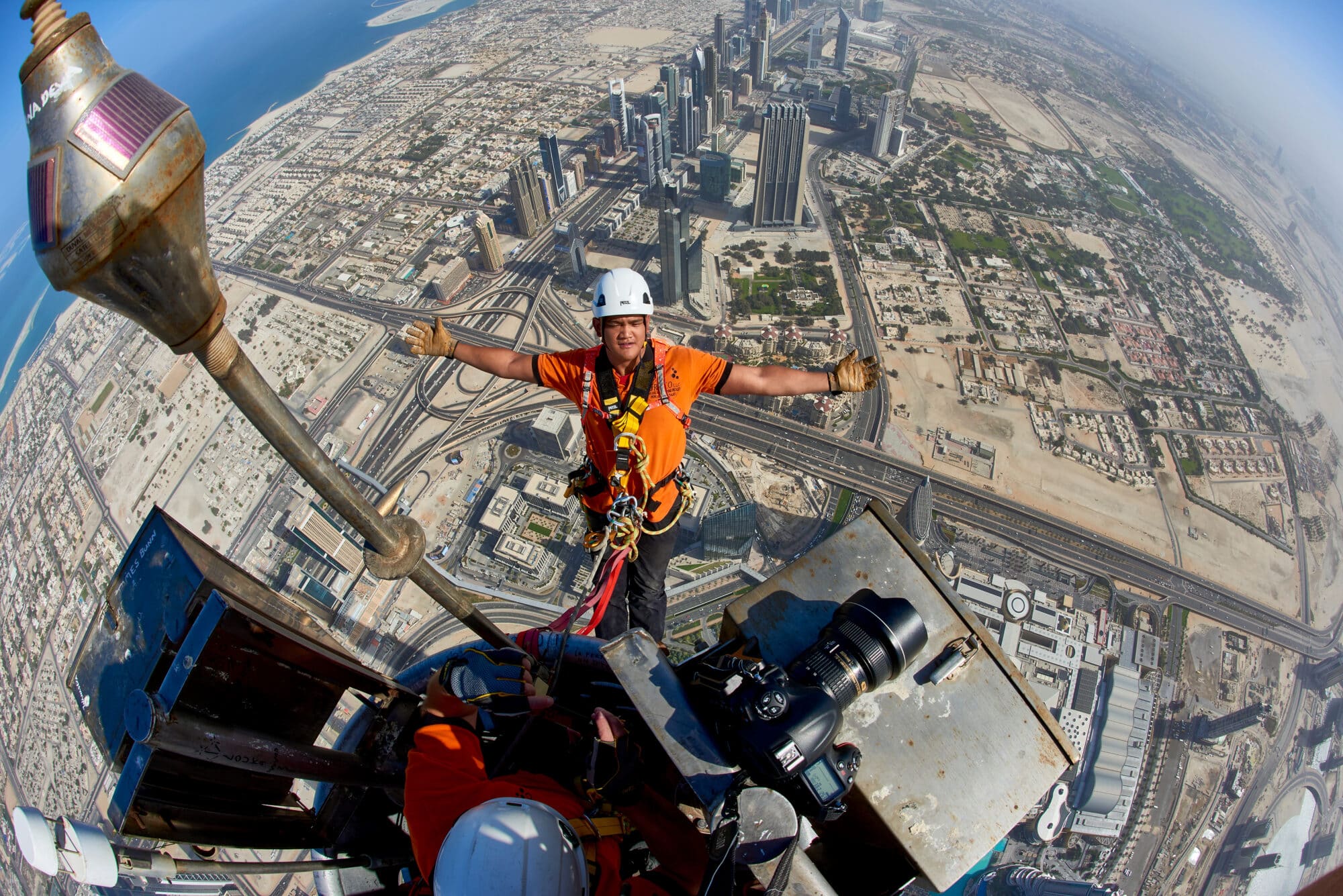
There are lots of production pix, such as the above, courtesy of Jay Mann, and sketches all over the place, courtesy of Numnuts.
The main deal with the book, and why I wrote it, actually, was to cover the gear, the nuts and bolts, the machinery if you will, very, very thoroughly. And then, having done that, get to the much more important questions about why we shoot. As I say, the “how” serves the “why.” There are several chapters called TITIK by my irrepressible editor, Ted Waitt, short for, “Things I Think I Know.” These are simply life lessons derived from 35 years of photography, all over the world, for all sorts of clients. Things to be aware of. Things to avoid. How to behave when things go wrong, knowing that they often do. Advice, if you will, on how to survive and navigate these perpetually uncharted waters.
Why big flash instead of small flash? Why does a certain face need a certain light? Why f11 as opposed to f2? Why would you choose one face over another? How to move fast, in a swirl of uncontrollable events, and keep your cool, light well, and come away with pictures. Building trust on the set, with models and crew. Self assigning, the key to everything. Mixing big flash and small flash. (The lede to that section: “THE BIG LIGHTS FORM YOUR SENTENCES. The little lights are the punctuation marks.”)
How to tell stories with light. How to use light as language. The underpinnings are technical, to be sure, and information about technique abounds in these pages. But the soul of the book resides in the realm of reasons we are compelled to use that technology to shoot. And why, despite repeated failure, we never, ever lose that boundless enthusiasm the eye exudes when it is comfortably nestled into a lens. For those moments at the camera when everything works, I express thanks.
“…. I remain thankful to be a photographer. In the midst of the torrent of technology we swim in daily, the unchanging mission for all shooters is to make pictures that arrest the eye of the viewer and describe our chosen subjects eloquently. We are part of an honored tradition, that of storytelling, which goes back to the dawn of time. Those prehistoric people, painting on their cave walls—were they doing anything different than we are now, with all our pixels and technical wizardry? I think not. They were leaving their footprints, and telling the story of their times, and their lives. With those ancient pigments on those rough walls, they were saying one simple thing: Remember us.”
Remembrance is important, and the discussion of how we achieve significant remembrance, for us and our subjects, is ongoing and important. As I say, again, in the intro section….
“The discussion is important, because talking about this stuff makes us all better shooters. It’s just that when the talk starts and stops at the numbers, and the whole world revolves around the precious, soulless hardware in the bag, we miss the point. The point is the picture. The conversation starts there.
So we do need to know the numbers, and that’s a beautiful thing because they are, indeed, knowable. There are good, clear, reproduc- ible, precise approaches, distances, f-stops, and shutter speeds here in this book, and elsewhere. Sure-footed knowledge of technique feeds your pictures, and grows your confidence. and that confidence enables you to pursue ever more aggressively the answers to the far more interesting questions that are really the heart of the matter.
So read on, if you will. Study the numbers. Learn the techniques. Ask the questions. Create your own beautiful pictures. Risk failure. Court disaster. Entertain possibilities.”
This is a book about what might be possible when you pick up a camera.
More tk….
As the bhagwan said, “The only thing certain is change,” and that’s definitely the case with digital camera stuff. Nikon announced a new flash today, the SB-910. It’s actually not really a brand new flash, but rather a collection of tweaks to the existing 900 model.
Absolutely the most important adjust is in the area of heat management, which has definitely been an issue with the 900, of which I have fried at least two in the course of time. From what I know of the electronics of the 900, they’re designed for fast recycle, and thus build up a heat component. The engineers, being the sane and safe souls that they are, installed a thermal cutoff in the 900, which is designed to shut the unit down prior to meltdown. I have always argued with the folks at Nikon that the cutoff feature should be coupled to a klaxon horn on an interval timer, blaring every five seconds or so, with an ominous voice intoning in between warning honks that imminent evacuation is highly advisable. Think Sigourney Weaver rescuing Newt at the end of Aliens.
They didn’t go for it.
But, in this unit, they did take the whole heat thing seriously, and it appears to be much, much better in that regard. Borrowing from the SB-700, there is improved thermal cutoff technology. Much more consistent, continued performance when pushing the unit hard.
This is opinion only, not hard scientific fact. I got a last minute call from Melville, asking me if I could shoot (quickly) a package of pictures to accompany the release. It took me about .5 seconds to say yes. I did what I usually do–take ‘em into the field and try and knock the bejeesus out of them. I had ran them pretty hard for three days, trying to use them in different ways. For instance, the above pic is shot with three units together on a Tri-flash, spreading out the light, running at 1/4 power each. My light shaping tool? Uh, see below….
Thank goodness for battered, white trucks parked in fortuitous places. I didn’t have a big soft box, so this worked out as a light source as Jonathan went all sorts of Superman off the brick wall. Which he is amazing at doing. The below was shot with one flash, roughly on axis with the sun, powered up full. It produces a double shadow of Jonathan, generally to be avoided, but here, I liked it. It actually extends the shadow of his legs in a fun way.
The good news on the timing was that I was able to drive those long suffering folks at Peachpit just a little more crazy than usual, and we held my book for a few days to insert a small chapter on this updated light maker.
Sketching Light is on the press right now, and will ship in about 10 days. I have many apologies to offer for delays in writing this puppy. It took a while. The good news there is that it delayed just long enough to be the first book to have a look at this new stuff. More on Sketching Light in day or so, but, thankfully, it’s real, and done, and about to ship. It’s also, BTW, 420 pages. Yikes. As the sub-title suggests, it’s all about the possibilities of light. Lots of pictures, most of them driven by one source. Sketches, metadata, production pix. The whole skinny on each picture. Now that it’s done, I can honestly say it was fun to write.
Back to the flash. It’s got a couple new features, like click-on, hard plastic color conversion gels for tungsten and fluorescent, a dedicated menu button, and a locking feature on the battery compartment. And, the buttons are backlit, handy for night shoots, for sure.
I took them into a bar. (Where else at 10am?) And knocked out a multi-flash portrait of Jake, which was fun to do. Six flashes, all told, all TTL. Shot with fast glass, 35mm f1.4, at f1.4. Production snap below.
More on these TK, and in the book.
Summing up: Physically, a little bit sleeker and smoother. There’s a design continuance with the SB-700, so if you use that flash, this one will be a no brainer in terms of buttons and dials. Some other small stuff, mentioned above, that’s helpful. But the biggie is the heat management. They seem to wrestled with that particular SB-900 demon pretty successfully. In the three days in the field I had with them, they only complained a couple times, but kept performing, and kept exposures consistent. I used them in the studio and in the street.
Here, with Jasmine in the studio, I really pushed the overhead main. It is firing into a Flashpoint beauty dish, with a honeycomb grid over it, and running at full power. The background streams of light are from 1k Arri’s, constant, daylight balanced sources. The fill is another 910, skipping off the floor.
The main light kept up pretty well, and I was shooting fast, trying myself to keep up with the ever fluid Jasmine. I purposely shot it before it recycled, just to see, frankly, if I could fry it. There was some exposure variance, but it hung in there, and kept working. During a shoot like this with the 900, the 900 most likely would have given up, and I would have had to replace it with a fresh flash, or certainly fresh, cool batteries. So, there’s definitely improvement on a speed light that’s already pretty smart.
More tk, on the flash, and the book…..
I’m thankful that when I take a picture, I can still hear the shutter:-)
I’m thankful for all the fancy new gear we have available to us as photogs, even though that time honored maxim of nothing working right when you really need it to still applies.
I’m thankful I still need to shoot about as much as I need to breathe.
And, I’m thankful there still remains a direct connection between my shutter finger and my heart and lungs. The very slight activity of that finger when it assists in recording what I might perceive to be a good photograph can completely arrest, for a split second, the activity of the other two. I’m thinking of donating my cadaver for forensic research so someone can write a learned paper about this physical oddity.
I’m thankful for Lynn in my studio, who in addition to producing jobs, paying the bills, keeping us afloat, and answering the phone creates a wonderful atmosphere of friendship, fairness and frivolity at our tiny shop.
She in turn is thankful that I don’t answer the phone, because when somebody calls and offers us zero for the rights to use our work, I’m prone to use the f word a lot, and we’d rapidly not have to answer the phone anymore, ’cause no one would call us ever again.
I think I’m thankful that the reprint rights to all photos recorded and yet to be recorded by any medium heretofore, forthwith and yet to be devised that will be reproduced at some point on the moons of Uranus via holographic transmission in future millennia are so desirable. That means us camera clickers must be doing something right, because, seemingly, everything we produce is truly excellent, valuable and will withstand the test of time.
Pursuant to all that, I’m thankful and still amazed that the phone does ring and people offer to pay for that which I would gladly do for free, most of the time.
I’m thankful my dad had a Beauty Lite III rangefinder camera which I borrowed in 1973.
I’m thankful, actually, for all the crazy jobs, long hours, heavy gear, busted assignments, heartache, insecurity, overfull credit cards, flight delays, outright despair, and the general personal and professional mayhem that swirls about the act of being a photographer like a personal mini-twister. All that bad stuff is like the debris on the sides of the road of one of those post-apocalyptic movies. Stay the course, stay on the path, and it leads somewhere, like to the reward of a very occasional good picture. I’m thankful for that road, and the many lifetimes spent on it, even though I walk it now not so much in purposeful, smooth strides, but more of a broke down shuffle, kind of like Wily Coyote after an unfortunate encounter with an oncoming train. It seems a small price to pay.
I’m thankful for the gang down at Tampa, the Kelby tribe. They define fairness and decency.
I’m thankful for all the pixels, even though I don’t need anymore than I already have. If I end up getting some more, I don’t know where I’ll put them. I came into the studio the other day and a whole bunch of them were hiding under my chair.
I’m thankful Ernst Haas made a book called The Creation. At the end of a tough day in the field, just looking at it is like taking a shower.
I’m thankful for Sid and Michelle Monroe, whose wonderful Santa Fe gallery remains a place I go to remind myself of why I continue to do this.
I’m thankful to the bunch of folks who read this blog, or come to a workshop, and engage in a passionate pursuit of be being a better photographer. That pursuit is life long, and worth it.
I’m thankful that Drew, Cali and Lynda in my studio put up with me. They are terrific colleagues, and wonderfully talented.
I’m thankful Derek Jeter continues to play baseball, excellently. And I think I’m thankful, at least on one level, that the NBA season is in the dumper. That means a disappointing showing by the Knicks will potentially be avoided, at least for a time.
I’m thankful for my kids. Claire likes school. Caitlin might yet find what is very beautiful and worthwhile inside of her.
I’m thankful Jay Maisel didn’t become a painter. I’m also glad he throws the f-bomb freely. Some folks might be offended. I think it’s just creative use of language.
I think I’m thankful for Vincent Laforet’s blog, even though I can’t even pronounce most of the stuff he talks about.
I think I’m thankful for Google Plus, though I don’t know how to work it yet. I know it’s important ’cause Dave Moser at NAPP kidded that he was going to punch me if I didn’t add him to a circle. I don’t know. I might hold off just to test if he’s serious or not. On the other hand, that might be unwise, ’cause of the many wonderful things Dave is, “kidder” might not be one of them.
I’m thankful for my ten year friendship with Donald Blake in Santa Fe. His wise and mischievous face is the cover of my new book. We are now bound together, via a picture, forever.
I’m thankful I’m still able to travel into the land beyond the yellow border. The folks at Geographic continue to tolerate me. I’m also thankful that NGS photogs are largely not included in most of the conference calls, and story pitches, and all those magazine machinations that need to occur. We’re field people. We don’t do well in an office, or in meetings, for lots of reasons, including the possibility that we might actually say what we’re thinking out loud. Best to just shut up and shoot.
I’m thankful I’ve been around long enough to have known Eisie, Gordon, Carl, and Mr. Mili. And to still know John Loengard, Ralph Morse, Jim Stanfield, David Douglas Duncan, Neil Leifer, Walter, Johnny I, and so many, many legends who have taken up a camera over time. Their work is the bedrock on which we all stand.
I’m thankful airplanes generally go interesting places, ’cause I’m on them a lot.
And this year, I’m thankful for ground transportation, in the form of a cartoon decorated bus that logged 14,500 miles across this country. For all the folks who saw fit to come out to Flashbus, many, many thanks. For DH, Jeff, Grippi, Lenz, Cali, Drew and Phil–all praise.
The above mentioned crew riding on an enclosed, wheel borne metal can for six weeks also makes me thankful for air freshener.
And yes, I’m thankful for manual.
And I’m thankful for camera manuals. And for the fact I’ve really never read them.
Once, a video producer, exasperated by my antics and non-sequitur behavior during the shoot, looked at my ever patient wife, Annie, and asked, “Is there an off switch?” Her response: “I’ve never looked for it.” For her kindness, decency, patience and love, I am forever thankful.
Had a wonderful time yesterday at NAPP. Just great. The folks in Tampa are well and truly family. We started the day with The Grid, with Scott Kelby and Matt Kloskowski throwing out questions to Trey Ratcliff and myself about popular “myths” or rules that get passed around in photo circles, like, “Never shoot somebody’s portrait with a wide lens,” and the like. There was some good discussion in the midst of general mayhem and laughs.
Then, last night, Scott led me through a fast paced Q&A in between clips of the most recent video I did with Kelby Training called, A Day with Joe McNally. Scott is so sure footed, both in the video and on the set, in terms of leading the conversation, and steering it in a positive, informative direction, that three hours passed quick as a blink. People sent in some wonderful questions, and the whole thing was pretty lively. The thing that always gets reinforced to me during these exchanges is how much passion there is out there for shooting pictures, which is, you know, pretty great.
My thanks go out to Scott, RC Concepcion (who shot the above pic), Brad Moore, Nancy Masse, and the whole Kelby Training operation. I’ve done videos with the Tampa gang since the start of their online training efforts, and watched it, in short order, become literally the best resource anywhere for photo and post-production education. As an instructor, you’re able to teach well, and have fun doing it.
The video of Scott and I in NYC is going live today, so check it out here.
Looking forward to hanging with Scott Kelby and the gang down at Tampa this week. (Click on the image above.) Scott and I did a video together in NYC recently, where we started in the wee hours, right at my studio, in the equipment garage, packing the truck and talking our way through the shoot. We talk about the whole deal, from why certain equipment gets brought or not, to strategies for survival on assignment, to location difficulties and solutions. And not just the nuts and bolts. We talk back and forth about the why of a job, the choice of a subject and the motivation to put your camera to your eye in the first place. And, we wander through the workroom, checking out the stuff on the walls, the accumulation of thirty years of imagery, sprung from travels to what is now over 60 countries.
See the picture up above? I look a bit reserved, don’t I? Calm, almost. Well, as you know, it’s anything but calm when Scott and I get together, yakking as we will in the studio on Wednesday night, and also in the location video we did this summer. It’ll be no holds barred, and all questions welcome. Here’s the link to register.
During the day of the video, I shot dance in NYC, at the old Brooklyn Navy Yard, which was a kick, and something I have always loved doing. Below are a couple of shots we generated that day, one with Jonathan, an amazing dancer who uses the urban environment of NY as a springboard for his artistry, and the other with Jenny Ringer, one of the most elegant principal dancers with the New York City Ballet. Just a great day at a great location.
Hope to chat with you on Wednesday! More tk….