Archive for the ‘Lighting’ Category
First off, to be square, I swiped this technique from Gilles Bensimon, the legendary fashion shooter. I was invited onto his set in Paris years ago, when I was shooting my first cover for National Geographic. It was an amazing adventure, a story on sight. Can you imagine? It was like being given a grant to simply go be a photographer. It took a year of my life, and I shot about 1500 rolls of Kodachrome.
I was all over the place, from the hi-tech halls of Johns Hopkins’ Wilmer Eye Clinic to the tribal villages of Africa, documenting eyesight, how it works, what can happen when things go wrong and how to fix it.
So what was I doing on a fashion set in Paris? Eye makeup. The beauty of the eye. Gilles was enormously gracious and totally easy about my presence on his set. He said, “You, you have ze best job, ze shooter for ze National Geographeec!” I looked over at him, easy in a director’s chair, sipping espresso and looking over portfolios, just generally awash in impossibly tall, angular fashion models, and I thought, “You, you have ze pretty nice job yourself!”
My pictures from that day never got published, but a much more important thing has stuck with me, as I observed him. He was working a cove type of studio. (Think of an egg, and then cut it in half. You’ve got a cove.) Most photogs place the subject in the cove. But he used the cove as his light source. First, he washed his lights off of V-flats. Their shape collected the flash and bounced it backwards into the continuous white curves of the cove, which then pushed it forward and deposited it on his model like a giant wave of light. Ping pong with light! Over the years, I’ve occasionally adapted a version of this for small flash lighting, with fairly happy results.
Here’s the thing–you, the shooter, are standing right in the path of all this light, but there is so much of it freight training towards your subject, it doesn’t notice you standing there at all. You don’t throw a shadow, or interrupt the light pattern. But you’re there, right in the middle of your subject’s eye.
It’s really nice light, done easily, either manually or TTL. The key is the foam core boards. Black on one side, white on the other. You need 4 of ‘em, to make 2 V-flats. Strip the vertical edges of the boards together, and voila, you’ve got V-flats. They are incredibly versatile around the studio as cutters, flags, bounce boards, background lights, and, as light sources.
To do this type of light, you don’t need a cove, thankfully, ’cause I sure ain’t got one. All you need is a white wall. Here’s what the set looks like.
And another view.
I’ve got two small flashes into each V. (You can easily do it with one apiece.) Keep the flashes above your subject’s eye line. The light will look and feel more natural. Cool thing? See my commander flash hot-shoed to the camera? This is one of those rare instances I use the hot shoe master as both a master and a flash. It is pointing directly back at the wall with the others, commanding them, but also adding a bit of pop. (It tends to be a little punchier than the feel of the units in the v-flats, because it is only bounced once.) The other fillip you can introduce is what you see Mike Cali doing in both of the above production pix. He is holding another light (in another group) and bouncing it off the white seamless paper on the floor. This gives another, sort of fashion-y dimension to the light scheme. A little low fill. Just a spark.
Other things to look for? Don’t get your subject too far away from you. If the light has to travel a real long ways, it will get harder by the time it hits them. You can also do this with big flash. Same deal. In fact, at the recent workshops we interchanged this approach back and forth a fair amount, so I really lost track of what face was photographed with big light or small light, the quality is so similar.
So, to recap. The V-flats are oriented vertically, taped together at the edges. The V opens back onto a white wall, or seamless. Put one or two small flashes into the V. (And I mean into it. Not outside of it, you’ll get hard spill jumping around the set.) Run these as a main light source, for instance, Group A. On camera speed light is Group M, active as a flash, and a commander. The low floor bounce becomes Group B, if you choose to use it. You can dial the groups up or down as you see fit, depending on the feel of the light.
It works. It looks and feels like daylight, and a lot of it. The ricochet aspect of this light pattern allow the small flash to get big off the v-flat, and then get even bigger off the white wall. The multiple units create possibilities for healthy f-stop, though, as I said, you don’t need lots of speed lights to try this. It works well with minimal gear, and minimal f-stop. Below is Numnuts at work.
More tk…..
Been shooting like mad lately, experimenting, pushing a bit. Had a great session with Baakari Wilder recently, one of the world’s premier tap dancers. He danced the lead in Broadway’s Bring in Da Noise Bring in Da Funk, and it was simply an honor to photograph him. The above was done with LED’s attached to his fingers and his tap shoes. One exposure with two pops of flash. It is in the realm we’ll experiment with during the coming lighting workshops in Dobbs Ferry in late July. We have altered the sked a bit, due to demand for the limited number of advanced lighting workshops we originally posted. The advanced techniques classes zoomed straight through to wait list status, so hit the link above to see the revised workshop calendar, as we have changed things up a bit.
June is always a busy month, so much so I’ve not been able to get down to teach the lighting class at DINFOS (the Dept. of Defense Information School, otherwise known as The Schoolhouse, at Ft. Meade). The lighting class has been left in the enormously capable hands of Tom Sperduto, recently of the Coast Guard, who is a non-stop force of nature with a camera in his hands. Check out his blog. Tom basically geared up as a dedicated shooter not all that long ago, and the amount of ground he has covered and reach he has now as both a shooter and a teacher is more than a bit amazing. He led this year’s DINFOS military phojo lighting class, and they made a movie of their week together. Check it out here.
They, uh, obviously responded to Tom’s teaching style. I’ve got a long history teaching young photojournalists in the military, and at our lighting workshops this year we’ve come up with an option that will make it easier for them to attend. Good bunch, who take risk a lot to make images in all manner of dicey situations.
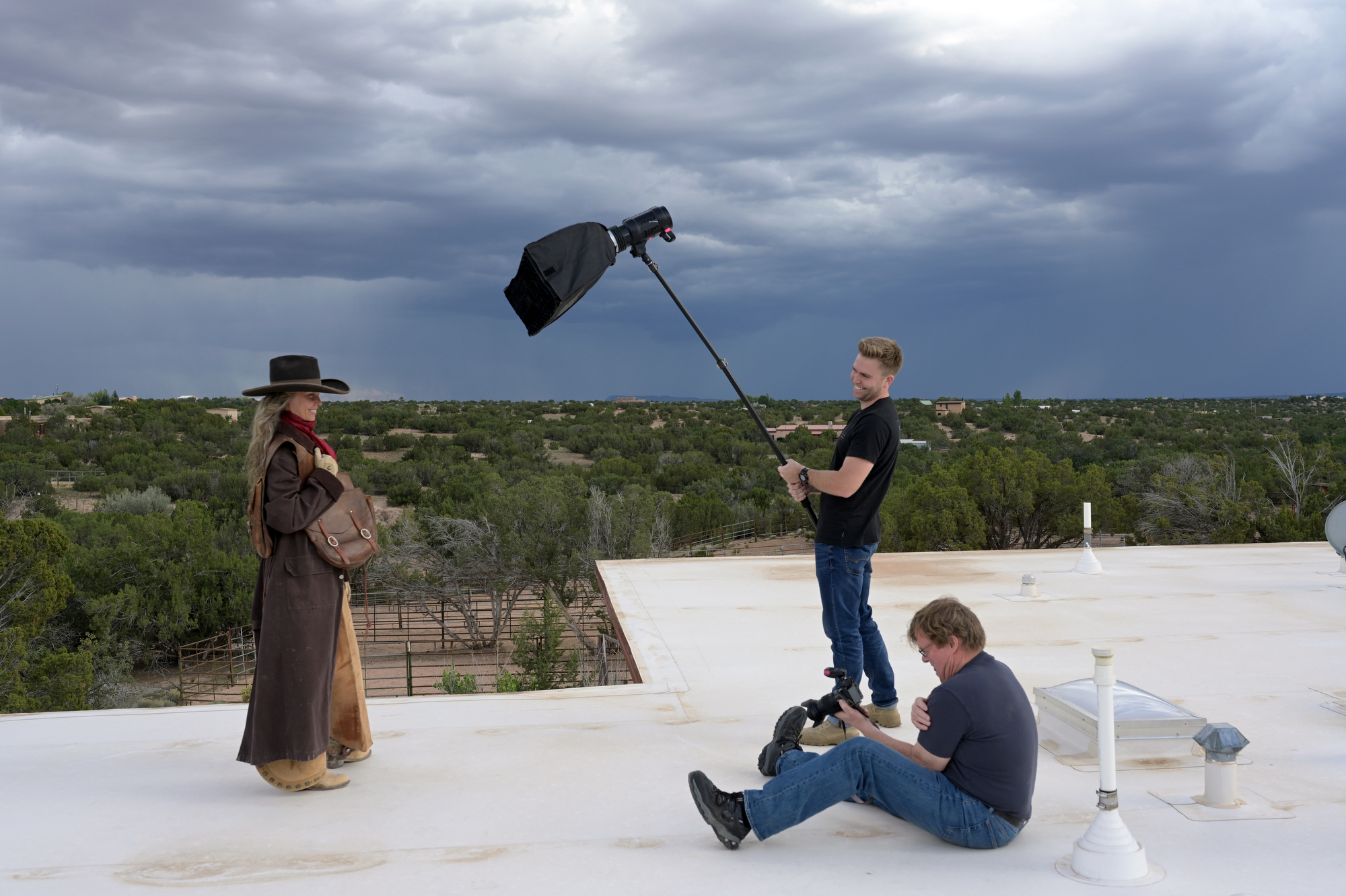
The Dobbs space we have is very cool, and this year we have access to the Hudson River, which we have never had before. Working in the studio, and the roof, and on location this past week, experimenting, which is the deal when it comes to lighting.
Shot the lovely Britney Jean Hying on the rooftop at Dobbs last week, doing her best Jean Harlow, in a vintage gown.
And the ever fluid Baakari on stage, with smoke and theater lights. Very simple flash….two SB 900 units up front, off to the sides. Raw light. Minimal gear and approach. It was just wonderful watching him create his own rhythm in response to the music. As he said, for a tapper, “The floor is the instrument.”
Hope to see you up in Dobbs. It’s already been a lot of fun…..more tk…..
I’ve been friend of the house since 911. Known as the “Miracle House,” they were among the first responders on that day, but lost no men. Miracle, indeed.
Capt. Jay Jonas (now a chief), and firefighters Matty Komorowski, Mike Meldrum, Billy Butler, Sal D’agostino, and Tommy Falco were with Josephine Harris, coaxing her down a stairwell, quickly, but not quickly enough, as all 6, who were aware the first tower had already come down, knew quite well.
They didn’t leave her, or each other. Which meant all of them were in the same space when the North Tower came down on them. Somehow, even though the entire landing rotated 360 degrees during the collapse, it stayed intact, and they all lived. Turned out Josephine’s pace of descent was a lifesaver. Those above and below that blessed piece of stairwell didn’t fare well.
If you want to read an interview account of that day, and those stairs, hit this link. Stone Phillips did a good job, letting the guys just talk about what happened in there, minute by minute.
Capt. Jonas (now chief)
Firefighter Bill Butler (now lieutenant)
Firefighter Sal D’Agostino
Josephine Harris
Firefighter Matt Komorowski (now lieutenant)
Firefighter Tommy Falco (retired)
Firefighter Mike Meldrum (retired)
They took a leap of faith and came to the Giant Polaroid camera, and are included in the book Faces of Ground Zero. Since then, the house and I have stayed in touch. They’re good people. And they handle a lot of stuff. Fighting fires in Chinatown has unique difficulties. It’s a warren of aging buildings jammed together in one of NY’s oldest and most charismatic neighborhoods, and, as one might imagine, not too much corresponds to building codes and blueprints. Surprise walls, mysterious, makeshift staircases, overloaded circuits, boilers that might have been built in the days of steamships–all this can present in the middle of the night, in the middle of a fire.
There’s been some big fires of late, lots of activity, and a bunch of the guys got medals, which was an occasion to have the whole house come together. Medal day. So, picture day. Call Joe.
I’ve done it before, a few years ago, in a rainstorm. I tell ya, if you gotta do a group shot in pelting rain, make sure it’s a bunch of firefighters. All smiles, not a word of complaint, everybody looking at the camera.
Last week, it was sunny, which was a different photographic problem, for sure. Did it all small flash, eight total, six on high stands. Three camera right, three camera left, master hot shoe unit doubling as a flash, and one up top on high boom, for good measure.
Now, you don’t see this type of light in the ads in Vanity Fair. Lush, it ain’t. But effective, yes. This shot isn’t about the light, or the shooter, or the numbers of pixels. This is about recognition, about every guy here going home and saying to his wife, girlfriend or kids, “There, see, there I am.” Not a time for subtlety, just a time to bring the light, and make sure everybody sees it.
Speaking of pixels, I shot it D3X, going to ISO 400. If I had to go higher, would have switched out to D3S, which handles higher ISO’s well. Had three groups going, all wireless, all manual. Yep, no time to mess with the TTL squirrels on this one. Sent them all a signal to go manual, ½ power and then tapered it to ¼. Which is the reason for multiple lights. Coulda done it with fewer, but would have taxed them pretty hard, and, it being an active house that could have gotten a call at any moment, I didn’t want to wait on recycle. Shot about 25 frames, and we were done. Told all the guys they had to see the camera with both eyes. You forget sometimes, you know, ’cause when you can see the camera you think it’s all cool. But you might be seeing it with just one eye, and that means the other half of your face ain’t in the picture. So I had the guys do the blink thing, back and forth, so I knew I had everybody’s eyeballs.
Also got the lights way high. Reason being, you want to fly the flash literally over the front rows to the back rows. Light from eye level the gang up front gets nuked before you can get anything to guys in the way back. So get the lights high up, and the downward spill will take care of the front rows.
Group shots are tough, right? Don’t know a single shooter who really likes to do them. About 1000 ways to screw it up, and only one or two to do it “right.” But it’s cool stuff, ’cause these are some of the most important pictures of life. This is the stuff of memory. These get passed on. These hang on walls.
Maybe, someday, when my pixels have long since turned to dust, one of the young guys in this picture, somebody with a girlfriend now, will return to the house with his grandchildren. He can point to this shot, hanging on the wall, and say, “That was me, a long time ago.” And they’ll look, and he’ll be there, face filled with light, looking at the camera with both eyes.
Keith Johnson (seated, 2nd from right) is a good guy, and the walking, talking definition of the word “gregarious.” He called out to me at camera and told me to make sure I made him look good. Told him no problem, I had a sub-menu of custom functions buried deep in my X that I’ve come to call the “Keith Johnson Function.” Just makes everybody look good. I’m thinking about talking to Nikon about it. More tk….
Been experimenting with seeing how far I can throw a commander signal from a hot shoe mounted flash to a set of remotes. Figured Dead Horse Canyon would be a good place to try. So last week, got up in the middle of the night and went out for sunrise in Moab. Got in touch with our bikers, Beth and Sean, through Poison Spyder Bike Shop in Moab, which, for me, has been the place to call if you want to work with good riders. The folks who either work there or are connected with the shop can really rock it out on a mountain bike.
Triggered the remotes from an SB900 on my camera. It had the diffuser dome off, and it was zoomed to 200mm, which is a good strategy for squeezing out a few more yards of range. All three remotes are hooked up on a c-stand via Justin Clamps. All have 1/2 cut of CTO warming gel on them, and they in turn are zoomed to 200mm, to get punch and direction along the lines of the rising (hopefully) sun.
Sean and Beth took turns, and I just kept adjusting at camera for the changing light. I was swinging the camera left and right to maybe do a pano stitch, so I took it out of aperture priority and just slammed it into manual. After experimenting a bit, I decided I needed all the juice I could get outta the lights, so I sent them a signal to fire at manual, 1/1, the max power you can get from the 900.

They both did great out there on the edge of the canyon. And the lights did okay, too. Consistent fire and recycle, ’cause each 900 was hooked to an SD-9 external battery pack.
Then there was this tree, which is evidently famous. It’s all bent up, kinda like it was growing one way and then decided to make a u-turn back the other direction. It’s cool looking, as trees go. My buds Kevin Dobler, Moose Peterson and I worked out a lighting combo that had two 900 units warmed up with CTO gel, and at first zoomed to 200mm, firing at the tree from both camera left and right, with each flash being about 20 or so feet from the greenery. Changed up the zoom when it looked like the lights were getting too spotty, and widened them both out to about 85mm. Group A to one side, B to the other, in case we had to ratio them differently. Saturated the sky with underexposure, and powered up the lights.
And, I became one with the tree. Figures. We’re both a little bent.
Couple schedule things….
Heading to Florida on Friday to teach lighting in Orlando, courtesy of the Orlando Camera Club. Great bunch of folks, and the organizer, Wayne Bennett has been tireless at putting together what looks to be a terrific program. Here’s the link….
More tk….
The Gulf Photo Plus gang has just posted the video from the shootout with David Hobby, Zack Arias, and Joey L. It’s a hoot. As I mentioned in an earlier blog, the crowd was the real beneficiary of all the humor, sweat and photographic expertise that was on display during each shooter’s allotted 20 or so minutes. I hadda boogie to the airport, so I missed the processing of the Polaroid with Joey L, but I was privileged to kibitz a bit while David and Zack knocked it back. It was, at the end of the day, after all the “I will crush you” bantering that occurred, just an event based on mutual respect and friendship amongst all the instructors. That of course, and treachery, skulduggery, pocket wizard frequency manipulation, swiped Canon cameras, model mayhem (in the sense there were two, instead of the assumed one), and some dip in the audience with a microphone offering inane commentary.
Check it out HERE.
More tk….